Making a fashion statement
While the road to circularity remains steep, Australian fashion innovators believe the industry is finally hitting a tipping point.

A handful of pioneering Australian startups are working to demonstrate that technical performance and environmental responsibility need no longer be a trade-off.
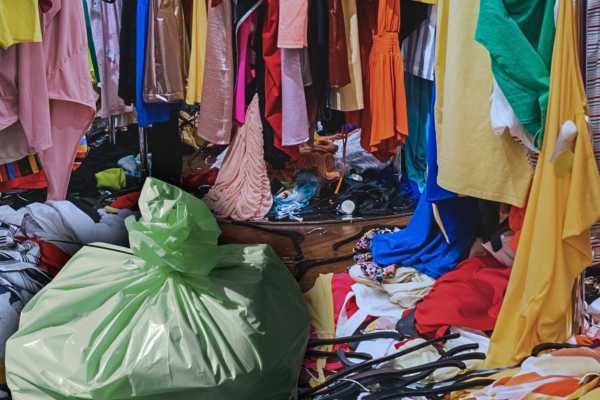
Australians are among the world's biggest consumers of clothing in the world per capita, with around 220,000 tonnes of clothing ending up in landfills annually, according to industry research.
This waste is mostly driven by the rise of fast fashion and a lack of organised collection systems, and has remained stubbornly high despite growing environmental awareness.
Yet, the tide is beginning to turn as a new wave of startups reimagines the lifecycle of our wardrobes. By building a circular economy from the ground up, these innovators hope to show that the future of Australian fashion is found in a closed loop rather than a landfill.
The infinite loop
Australian activewear label LSKD signalled its long-term commitment to circularity last week by securing a 10-year partnership with Sydney-based circular materials firm Samsara Eco.
Beginning in 2028, LSKD will integrate Samsara Eco’s enzymatically recycled nylon 6,6 into its product range, specifically across its leggings, bike shorts, and running bra lines.
"Performance and sustainability used to be positioned as a trade-off," LSKD’s raw materials and supply chain manager Logan McNally said.
"Nylon 6,6 is a phenomenal fibre; softer, stronger, more durable. The fact that it can now be made infinitely from end-of-life textiles without compromising those properties is what made this decision easy."
Samsara Eco, founded in 2021, uses AI-designed enzymes to break down end-of-life textiles, including complex mixed fibres, into their original molecular building blocks. These are then repolymerised into virgin-identical materials.
"Ten years is not a trial. It’s a belief in us, in circular materials, and in where the future of apparel is heading," Samsara Eco founder and CEO Paul Riley Said of the new alliance. "We’re at a tipping point for circular fashion."
The partnership is expected to coincide with the opening of Samsara Eco’s first commercial-scale circular nylon 6,6 plant in Asia, and follows a similar 10-year deal struck last year with Canadian activewear giant Lululemon.
Waterless dyeing
In Geelong, Victoria, innovators at Xefco are tackling one of the most resource-intensive stages of garment production: dyeing and finishing.
The company recently received a $5 million matched grant through the Federal Government’s Industry Growth Program to commercialise its Ausora technology, which was officially launched this week.
“This is a major milestone for Xefco as we take our waterless plasma textile dyeing and finishing to the world,” the company said of the launch.
The Ausora system uses chemical vapour deposition and plasma to apply colours at room temperature without using water in a process that Xefco said uses 97% fewer chemicals, 90% less energy, produces 94% fewer emissions, and produces zero wastewater compared to conventional methods.
Its Ausora units allow textile production to operate in water-stressed regions, according to Xefco, which late last year partnered with Indonesian footwear textile group Shinta Woo Sung (SWS) on the first commercial implementation of its tech.
The first unit is scheduled to ship soon to SWS’s new facility in Vietnam that will supply major international brands.
From denim to dwellings
While some focus on the fibre-to-fibre loop, others like Melbourne-based Planet Protector, are finding new life for textiles in the built environment.
The company reprocesses post-consumer denim fibres, originally designed to withstand decades of wear, into high-performance architectural insulation batts under the brand name Jeanius, diverting tonnes of fabric from landfill.
“Denim is one of the most durable fabrics ever made. It survives decades of wear and industrial washing. And when Australians are done wearing it, most of it goes into the ground,” Planet Protector founder and CEO Joanne Howarth said recently on social media.
“We asked a different question. What if denim's durability made it useful after the wardrobe?”
The Jeanius insulation range is produced at Planet Protector’s facility in Victoria, and unlike traditional glasswool or mineral wool, the batts are safe to handle without protective gear, according to their maker.
Planet Protector said it had also designed the product to be fully regenerative, so at the end of a building's life, the insulation can be returned, re-fiberised, and manufactured into new batts.
While startups lead on technology, a broader shift is being driven by Seamless, Australia’s national clothing product stewardship scheme. Launched by the Australian Fashion Council in 2024 and backed by the Federal Government, Seamless has bold ambitions of making the Australian clothing industry truly circular by 2030. The scheme aims to divert 60% of end-of-life clothing from landfill by 2027 and will incentivise brands to take responsibility for the entire life cycle of their garments through a 4-cent-per-garment levy – or 3 cents for garments designed for easier recycling. These funds are then funnelled towards the production of clothing that is more durable, repairable and easier to recycle. Funds will also go to those scaling models for rental, repair, and "re-commerce" to keep clothes in use longer, and for investing in the collection and sorting infrastructure needed to turn unwearable clothes into new high-value materials. Although Seamless is currently opt-in, the Federal Government is considering making participation mandatory to level the playing field for all retailers.
Related stories
 Amanda Bryan
 Amanda Bryan