Cultivating sovereignty
With fuel and fertiliser increasingly vulnerable to global supply shocks, Australia’s agricultural landscape is ripe for a technological revolution.


As we navigate a volatile global economy, farming has moved from the sidelines to the very heart of national security.
The ongoing energy crisis continues to strain traditional supply chains, pushing the costs of diesel and synthetic fertilisers to historic highs. In this climate, the nation's paddock-to-plate pipeline is no longer just an industry – it’s increasingly being seen as a critical pillar of sovereign resilience.
A wave of Australian AgTech innovators are now stepping up to help reshape the landscape and boost the productivity, profitability and autonomy of the farming sector. Here’s a glimpse at some of the new technologies that are rewriting the rules of the game.
Energy independence
The reliance on volatile diesel markets is being challenged by Melbourne-based startup Phnxx, which has developed a mobile microgrid-in-a-box.
Designed to replace traditional generators and costly grid connections, this rapidly deployable solution arrives on-site in a standard shipping container and unfolds into a high-capacity solar array.
The technology is already being used in the field. Following a $1.8 million seed round in March last year, Phnxx installed its first commercial unit on Peter Mulheron’s dairy farm in Colac.
The 105 kW solar system and 240 kWh battery are expected to provide 80 per cent of the farm’s power annually, protecting the farm against blackouts, milk spoilage, and rising prices.
In addition to agriculture, the system’s mobility also makes it suited to small mine sites and short-term construction projects across remote Australia, Phnxx says.
Small, smart & self-driving
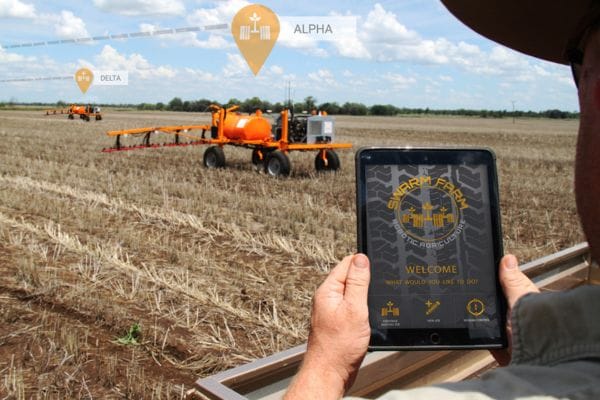
Queensland-based SwarmFarm Robotics hopes to shift the agricultural paradigm away from heavy, expensive machinery toward a smaller, smarter approach.
Its autonomous SwarmBots are lightweight, autonomous, self-driving platforms that operate via a mobile app and can function independently or as a coordinated team to reduce the use of fuel and chemicals and protect soil.
Through the SwarmConnect platform, third-party developers can integrate precision farming equipment to carry out farming tasks such as spraying, mowing, slashing and spreading, SwarmFarm says.
More than 230 units have already been deployed across 10 million acres by the company, which last year raised $30 million to fund its expansion.
Low-footprint fertiliser
Sydney-based PlasmaLeap Technologies hopes to boost food security by decentralising the production of nitrogen fertiliser.
Using technology spun out of the University of Sydney, its modular microreactors aim to enable the production of decentralised, zero-emission nitrogen fertiliser.
By combining air, water and electricity, these units use non-thermal plasma to produce ammonia and nitrate – the building blocks of most nitrogen fertilisers – directly on-farm, bypassing fossil-fuel-intensive industrial plants and volatile global supply chains.
PlasmaLeap attracted backing of almost $28 million earlier this year and is now moving from trials to real-world deployment, with initial fertiliser hubs being established in NSW and Tasmania.
Precision protection
As 2026 brings tighter biosecurity mandates and bans on high-volume pesticides, NSW startup Azaneo is rolling out a chemical-free weeding solution created to bypass this issue.
The tech uses irreversible electroporation – a technique borrowed from cancer treatment – to deliver high-voltage pulses to destabilise weed cell membranes.
Azaneo recently finalised a field beta prototype of its Pulsed Electric Field weeding technology, which is designed to integrate with existing tractors, with customer trials the next step.
The system is also more energy-efficient than thermal weeders and operates at speeds that match traditional methods, according to Azaneo.
Unlike traditional spraying, electroporation isn't affected by high winds, offering farmers a more weather-independent way to maintain yields and better navigate the increasingly restrictive regulatory climate, Azaneo says.
The startup secured a $250,000 Industry Growth Program grant last year to build a beta unit, validate its performance with growers, and demonstrate a commercially viable product.
Nurturing nature
In Western Australia, the state government is backing local innovators in the sector through the WA Nature Tech Accelerator.
In partnership with Founders Factory, the program has selected six innovators to scale science-based solutions from the lab to the commercialisation stage, with this latest cohort the first to be composed entirely of Western Australian-based founders. They are:
- Dura Terra, which makes microbial-coated granules to increase yields and rehabilitate acidic soils.
- SnailCam, an AI-powered camera system for real-time snail mapping and precision pest management.
- Syanterra, an AI-native developer building high-integrity carbon and nature projects.
- HydraLink, an AI-driven wireless irrigation for modern water management.
- HeatShield, a heat-tolerant algal probiotic designed to protect coral reefs.
- Vernico, which is commercialising medical-grade coconut oil products for healthcare.
Since its inception two years ago, 24 startups have passed through the four-month WA Nature Tech Accelerator program, which is operated by Founders Factory. The program provides one-on-one mentoring and masterclasses covering product development, strategy and operations, commercialisation, data science, partnerships, and fundraising.
“Western Australia’s innovation ecosystem continues to go from strength to strength, as shown by this latest cohort of bright founders,” said Minister for Science and Innovation Stephen Dawson.
“By partnering with organisations like Founders Factory, the Cook Government is helping local innovators turn big ideas into real-world impact.”
Related stories
 Amanda Bryan
 Amanda Bryan