The weekly roundup: ☀️Beyond the panel
In this week's news we examine the shifting landscape of sustainable tech from functional necessity to architectural innovation.

From the aesthetic evolution of Australian rooftops to the high-stakes physics of ‘artificial suns’, the boundaries of clean energy are shifting.
This week, we examine the ways sustainable tech is evolving from functional necessity to become a primary driver of architectural identity and innovation. In Victoria and Sydney, new developments are demonstrating that solar infrastructure can be a design asset rather than an eyesore.
Meanwhile, across the Tasman, the ambition runs even deeper. A New Zealand startup is challenging global fusion heavyweights with a different architectural approach to limitless power. Together, these stories reflect the breadth of the energy transition, from embedding renewables more seamlessly into tomorrow's skylines to steadily advancing the technologies that could shape the grid in decades to come.
Solar statement

The traditional view of rooftop solar as a purely functional add-on is shifting.
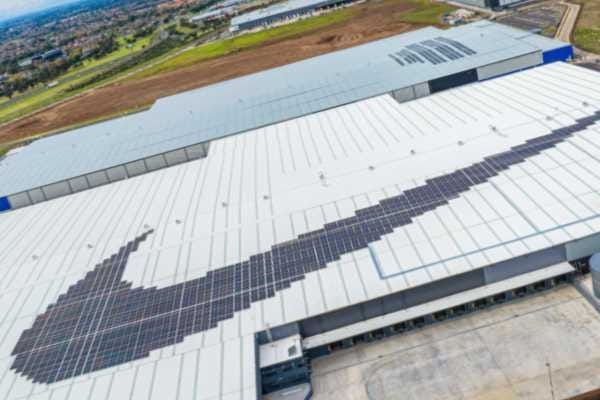
Rather than treating panels as an afterthought, developers are exploring architectural integration to make renewable energy a defining design feature. In Victoria, Nike’s Ravenhall facility has configured 5,200 square metres of infrastructure into its "Swoosh" logo, while the Sydney Fish Market uses an undulating canopy to mimic harbour ripples. The $308 million redevelopment of Sydney’s iconic City Tattersalls Club also demonstrates how solar can be woven directly into a high-rise form.
Fusion powers ahead

In pursuit of the holy grail of clean energy, New Zealand startup OpenStar Technologies has unveiled "Junior".
Last month it demonstrated its fusion prototype powered through an alternative levitated dipole architecture. By successfully levitating a half-tonne magnet to confine superheated gas, the team aims for a faster, lower-cost path to clean energy. Supported by a NZ$35 million government loan, OpenStar joins international ventures like Commonwealth Fusion Systems and Helion Energy in their mission to deliver the first commercial-scale power plant to the grid.

▹Solar at scale
Newcastle startup Kardinia Energy has secured $2.1 million from the Australian Government’s Industry Growth Program to commercialise its flexible printed solar technology. Unlike traditional panels, its solar offering is lightweight, recyclable, and designed for diverse energy applications. Kardinia says the grant will fund a pilot manufacturing facility as it scales its operations.
▹Renewables call for data centres
An alliance of industry, union and environmental groups has urged the federal government to require new data centres to invest in renewable energy, protect water supplies and support local skills as Australia’s AI-driven infrastructure expands. The proposal is backed by the Clean Energy Council, Electrical Trades Union, WWF-Australia, the Australian Conservation Foundation, Smart Energy Council, RE-Alliance, Climate Energy Finance, Nature Conservation Council of NSW, Environment Victoria, Queensland Conservation Council, Sunrise Project Australia and Carbon Zero Initiative.
▹Climate Action Week
CAWSYD26 returns to Sydney next week (9–15 March) and organisers say this year's program features over 250 events with the goal of showcasing local climate action, youth participation and First Nations leadership across the Greater Sydney area. Events include a Climate Tech Careers Night, Business with Purpose leadership talks, an Electric Vehicle Rally and a Living Seawalls Tour.
▹Lab-grown fruit and nuts
NZ cellular horticulture startup Forever Harvest has raised NZ$1.2 million in a pre-seed funding round to accelerate development of cultivated fruit and nut ingredients. The startup uses cellular horticulture to grow specific fruit and nut cells in labs with the goal of providing climate-resilient, year-round supply amid rising crop volatility. Forever Harvest said it would use the funding to expand pilot production and commercial partnerships. The round was led by Sprout Agritech, with support from the Bioeconomy Science Institute and Callaghan Innovation’s Deep Tech Incubator program.
▹Cleaning up Australia
Clean Up Australia organisers say the nation’s largest community event, now in its 36th year, saw 750,000 volunteers across 8,000 locations tackle the nations litter crisis. Clean Up chair Pip Kiernan said plastics comprised 80% of all finds, cigarette butts were the most littered individual item, and vapes turned up at more than a third of surveyed sites. "This is what our volunteers are finding under their feet today, and it is a call to action for every single one of us," Kiernan said.