Federal boost for electric freight
A zero-emission road freight depot has been named as one of four projects selected in a fast-track federal pilot.

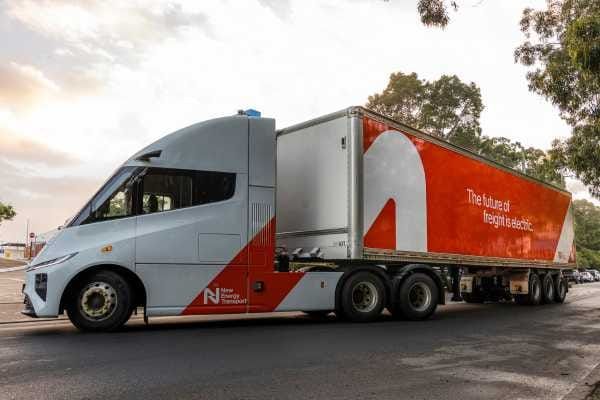
A proposed electric truck depot south-west of Sydney has been selected for a government program aimed at projects deemed to be in the national interest.
New Energy Transport’s (NET) Wilton Project is a planned large-scale, zero-emission heavy road freight depot, and was one of four projects chosen to take part in the new Investor Front Door program announced last week by Treasurer Jim Chalmers.
As Australia continues to face fuel supply shortages and rising grocery costs, the government says it selected the pilot projects for their capacity to boost Australia’s fuel security, supply chain resilience and critical-minerals pipeline.
The Investor Front Door aims to streamline interactions for project developers and businesses navigating the regulatory approval processes in order to fast-track the projects that it considers to be in the national interest.
“The supply chain disruptions we are seeing as a consequence of the conflict in the Middle East demonstrate just how important it is to build up our sovereign capability in these essential areas,” the government said last week.
Heavy lifters
NET said its participation in the pilot project reinforced the strategic importance and economic potential of electrifying Australia’s heavy road freight infrastructure.
As the operator of a fleet of fully electric prime movers powered by wholesale renewable energy, it describes itself as a new type of trucking company with the goal of outperforming diesel-based freight on both sustainability and cost.
"This announcement confirms that electrifying Australia’s road freight infrastructure is a national economic and security priority," NET Co-CEO Daniel Bleakley said.
“Electric trucks offer a pathway to decouple Australia’s freight system from volatile global energy markets, dramatically improving supply chain resilience and national energy security.”
In addition to ongoing fuel supply pressure, the transport sector is the third largest source of Australia's greenhouse gas emissions according to government figures, with road freight contributing significantly to this total.
"Electric trucks offer a pathway to decouple Australia’s freight system from volatile global energy markets, dramatically improving supply chain resilience and national energy security."
Last year NET announced it had achieved the country’s longest single-charge electric truck delivery, completing a 480-kilometre round trip between Picton and Beresfield, near Newcastle.
During the demonstration, a fully loaded 36-tonne haul operated by Multiquip and transported by a Windrose electric truck, completed the journey 12 per cent faster than the standard diesel delivery, saving 20 minutes on each leg of the trip.
NET says it also recently completed Australia’s first all-electric ‘end-to-end’ freight delivery between Sydney and Canberra in partnership with last-mile delivery provider, ANC, and recycled toilet paper manufacturer, Who Gives A Crap.
The all-electric delivery, from distribution centre to customer door, delivered an 84% reduction in energy costs compared with a diesel prime mover on the same route, NET said.
Electric freight hubs
The Wilton depot will be the first in a proposed network of electric freight hubs to open up zero-emission freight transport between major cities, which NET says will reduce reliance on diesel freight and imported fuels.
The depot is being designed to support up to 50 heavy electric trucks on freight corridors between Sydney, Wollongong, Newcastle and Canberra, and is expected to be operational in late 2026. NET says it plans to expand services to routes between Adelaide, Melbourne, Sydney, Canberra and Brisbane by 2031.
“Our commercial deliveries have proven that electric road freight is not only technologically possible in Australia – it’s commercially viable and delivers real economic and productivity gains for our customers,” New Energy Transport Co-CEO Fredrik Pehrsson said.
The government's Investor Front Door program is due to run until mid-2027 and will provide an engagement manager to help projects navigate regulatory requirements, obtain decisions, and identify appropriate government financing options. Other renewable energy projects selected to participate in the government’s pilot include:
●HAMR Energy’s Renewable Fuel Project in Victoria and South Australia, which will develop two facilities to convert biomass into low-carbon liquid fuels with the aim of reducing emissions across a range of sectors like aviation and shipping.
●The Murchison Green Hydrogen Project in Western Australia, which is a green hydrogen plant producing large-scale green ammonia using wind and solar. It aims to provide a model for commercial-scale green hydrogen development and generate new green export opportunities to Asia and Europe.