The weekly roundup: 🌱Second chance for seagrass
In this week's news we take a dive into seagrass recovery in Sydney Harbour and look at modular reactors to produce nitrogen fertiliser on site.

Infrastructure challenges tend to be invisible, until they fail.
This week we look at two very different systems that have been struggling under the surface; the poorly designed mooring chains degrading Sydney Harbour's seagrass beds and fertiliser supply chains buckling under the forces of global volatility.
While neither of these issues lends itself to a quick fix, both of this week's solutions share an approach built on rethinking the foundations entirely – and in both cases, it is Australian innovation that is leading the way.
Seachange in Balmoral

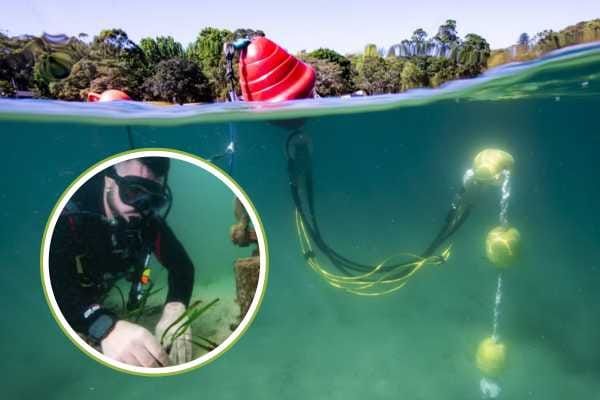
Eight hundred shoots of endangered Posidonia australis seagrass were planted last month at Balmoral Beach as part of a multi-year marine restoration effort.
Led by the Sydney Institute of Marine Science (SIMS), the project followed the replacement of traditional boat moorings with low-impact alternatives, creating better conditions for seagrass recovery in an initiative that is bringing together scientists, government agencies, and local boating communities.
Local fertiliser fix

A Sydney startup is developing modular reactors that produce nitrogen fertiliser on site, bypassing fossil fuel-dependent supply chains.
PlasmaLeap, which was spun out of the University of Sydney, raised nearly $28 million in January from backers including the Gates Foundation and global fertiliser producer Yara International. The funding will support hub rollouts in NSW and Tasmania, alongside continued field trials with growers.

▹Minibot cleans oil spills
RMIT University engineers have built a dolphin-shaped minibot that hoovers up oil spills using a filtering system inspired by sea urchins. The ‘Electronic Dolphin’ collects oil from the surface of water and is designed to offer a safer and more targeted way to respond to spills in sensitive environments. The proof-of-concept device, which is about the size of a sneaker, shows how small, adaptable platforms could support clean-up efforts without exposing responders to hazardous conditions, RMIT researchers said.
▹Old fridges in the crosshairs
Over three million fridges and air conditioners are being discarded each year, with many still containing harmful refrigerants that leak into the atmosphere, according to a newly released Australian white paper. Experts estimate each recovered appliance will prevent about 235kg of CO₂ emissions, but they warn that only 30 to 40% are being responsibly recovered. Researchers are calling for mandatory take-back schemes, stronger regulation, and in-home collection services to close this gap before 2040.
▹A 'heartbeat' for homeowners
German renewable energy company 1KOMMA5° has launched its Heartbeat AI platform Australia-wide. The platform was created to optimise household energy use by monitoring the wholesale electricity market and topping up batteries when prices are low, and selling when they're high. Available now, 1KOMMA5° says its existing customers can access Heartbeat AI at no extra cost, with a fully-integrated system on display at its new Melbourne showroom.
▹Helsinki slashes food footprint
Finland’s capital is blazing trails in sustainable food by pledging to halve its meat and dairy purchases for schools, daycare centres, hospitals, and other public facilities by 2030. The Helsinki City Council voted in the new procurement initiative, Puolet Parempaa (Half Better), in February, positioning the city as a frontrunner in sustainable food procurement, as reported by Green Queen.