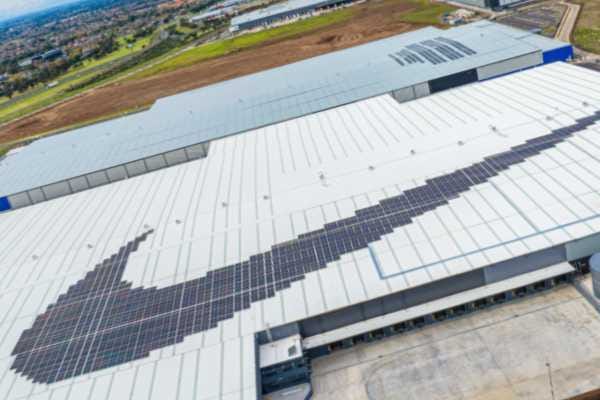
Cool roof, fresh water
The University of Sydney has developed a paint-like coating that could keep buildings cooler and produce water from the air.


With global temperatures rising, cities are facing more intense heat and pressure on water supplies.
University of Sydney researchers in collaboration with startup Dewpoint Innovations, have been testing a prototype roof coating that they hope can address both issues.
Atmospheric water capture operates by condensing vapour on a cooled surface, and while it could offer a promising solution to global water scarcity, it usually requires substantial energy.
The researchers have created a nanoengineered polymer coating designed to passively cool buildings and capture water directly from the air without power.
The coating is made from a porous polymer that reflects 97% of incoming sunlight and radiates heat away, potentially paving the way for roofs that could reduce inside temperatures and supplement tank water.
Even under full sun, the coating can stay up to six degrees cooler than the surrounding air, the researchers say, creating the right conditions for water vapour to condense into droplets on the chilled surface, like steam forming on a bathroom mirror.
Testing the waters
During six months of field trials on the roof of the Sydney Nanoscience Hub, researchers found the coating collected dew on 32% of days, even when there was no rainfall.
The study, published recently in Advanced Functional Materials, found that under ideal conditions, the surface could harvest 390 mL of water per square metre per day, enough to meet one person’s daily drinking-water needs from a 12-square-metre area. The coating also showed durability with no degradation under harsh sunlight, the study found.
“This technology not only advances the science of cool roof coatings but also opens the door to sustainable, low-cost and decentralised sources of fresh water – a critical need in the face of climate change and growing water scarcity.”
Even dry regions experience humidity spikes after sunset, the researchers noted, which is enough for the coating to work. With larger surface areas, they say, the paint could have potential in industries like animal care, horticulture, mist-based cooling, or hydrogen production.
“This technology not only advances the science of cool roof coatings but also opens the door to sustainable, low-cost and decentralised sources of fresh water – a critical need in the face of climate change and growing water scarcity,” said research lead and chief technology officer of Dewpoint Innovations, Professor Chiara Neto.
“While humid conditions are ideal, dew can form even in arid and semi-arid regions where night-time humidity rises. It’s not about replacing rainfall but supplementing it – providing water where and when other sources become limited.”
Professor Neto, who holds a stake in Dewpoint Innovations, noted that dew-collecting roofs could complement current systems such as rainwater tanks.
“Imagine roofs that not only stay cooler but also make their own fresh water – that’s the promise of this technology,” she said.
Last year, environmental researchers predicted that out of 304 large cities with more than one million people, between 88 and 99 per cent would face increasing scarcity or declining water quality by mid-century, with about one-third experiencing both pressures.
Cities worldwide have also become hotter since the 1990s, with the number of extremely hot days increasing by 25 per cent, according to a recent analysis by the International Institute for Environment and Development (IIED).
If successful, the coating could also help to mitigate the urban heat island effect during extreme heat events and boost the energy efficiency of buildings.
From lab to roller
The university research group’s innovation has been licensed to startup Dewpoint Innovations, which is now developing the prototype into a standard water-based paint that can be applied with conventional rollers and sprays.
“At Dewpoint, we’re proud to partner with the University of Sydney to bring this breakthrough in passive atmospheric water harvesting to life through advanced paint-based coatings,” Dewpoint Innovations CEO Perzaan Mehta said.
“It’s a scalable, energy-free solution that transforms rooftops and remote infrastructure into reliable sources of clean water, helping address an urgent challenge of our time.”
While atmospheric water capture offers a promising solution to global water scarcity, it operates by condensing vapour on a cooled surface, a method that uses substantial energy. The University of Sydney’s paint-like coating can cool using no power thanks to a porous fluoropolymer with an internal microstructure that delivers extremely high broadband solar reflectance without the need for UV-reflective pigments. This allows the coated surface to drop by up to six degrees below ambient temperature even in direct sunlight, according to its creators. Once the surface cools below the local dew point, atmospheric water vapour condenses into liquid.
Related stories
 Amanda Bryan
 Louisa Hearn
 Amanda Bryan