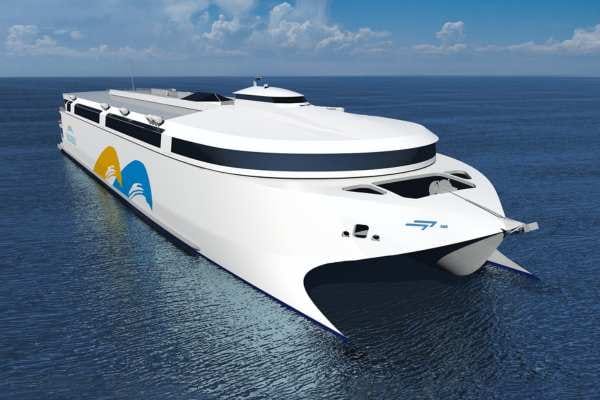
Hobart trials world-first electric ferry
Large battery-powered passenger vessel begins real-world testing in Tasmania, in the next step for low-emission shipping.

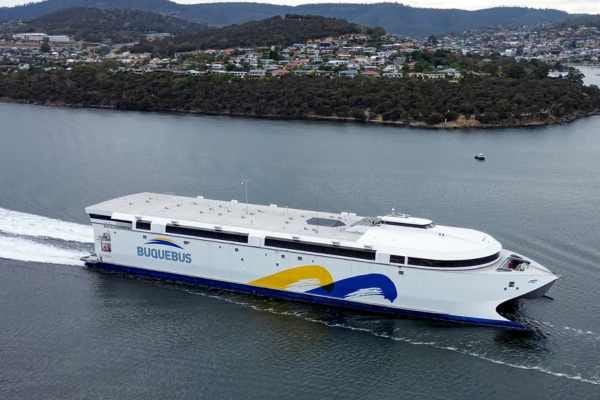
The River Derwent has become a testing ground for the future of maritime transport as Incat Tasmania puts its 130-metre ferry through its paces.
Marking a historic transition toward zero-emission shipping, Incat is conducting trials on the electric vessel, known as Hull 096, as part of its testing and commissioning program in real-world conditions.
Commissioned by South American ferry company Buquebus, the ferry is designed to carry more than 2,100 passengers and 225 vehicles between Argentina and Uruguay, powered entirely by battery.
The current harbour trials have been assessing propulsion, manoeuvrability and control systems. Incat says it represents the first time a vessel of this size with passenger-vehicle capacity has operated solely on battery power anywhere in the world, representing a "significant step" in the development of large-scale electric shipping.
The trials began in mid-January when Hull 096 was moved from the shipyard to the harbour, travelling under its own battery-electric propulsion for the first time.
Since then, Incat says further runs on the Derwent have allowed crews to examine how the ship performs at speed and how it handles on the water in real-world conditions.
"Moving Hull 096 under its own battery-electric power is a world first at this scale and confirms that electric propulsion is viable for large commercial vessels."
Incat chairman Robert Clifford said the testing phase represented a critical moment for the project. “This is the moment where the ship truly comes alive,” he said. “Moving Hull 096 under its own battery-electric power is a world first at this scale and confirms that electric propulsion is viable for large commercial vessels.”
He said the results so far had been encouraging. “Seeing Hull 096 performing on the water after years of design and construction is an incredible moment for our entire team,” Clifford said. “These trials have allowed us to assess the vessel’s performance in real operating conditions, and the results so far have been extremely satisfying.”
Clifford also highlighted the vessel’s low noise levels during operation. “One of the most impressive aspects is how quiet the ship is while operating under battery power. For a vessel of this scale, the smooth and silent performance is remarkable.”
Incat says harbour trials will continue on the River Derwent alongside final works at its shipyard, including completion of the vessel’s interior fit-out. Hull 096 is expected to be transported to South America by heavy lift ship in the coming months, marking the final stage of the project, according to the company.
Last year, Incat also landed a contract to design and build two electric ferries for Danish operator Molslinjen to operate on the Kattegat route between Denmark’s Jutland and Zealand.
Hull 096 is a 130m WPC (wave-piercing catamaran) vessel that's been designed to transport vehicles and passengers using a battery-electric propulsion system. This is powered by a 40-megawatt-hour energy storage unit – the largest installed on a vessel to date. This system feeds eight electric motors driving a water-jet propulsion system. The vessel is constructed from marine grade aluminium instead of steel, and Incat says its lighter weight substantially reduces the power needed for propulsion.
Related stories
 Louisa Hearn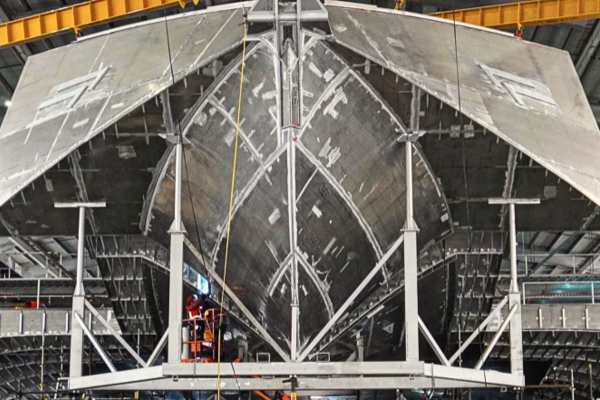
 Louisa Hearn