Battling the fires of the future
A rapid upgrade of fire detection and monitoring technology is underway as fire-prone regions seek to mitigate potential catastrophe.

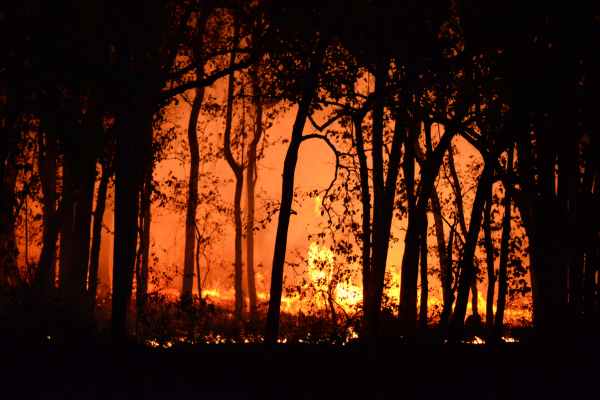
As bushfires once again reshape our landscape, Australians are waking up to the reality of living in an increasingly fire-prone world.
Fuelled by an intense heatwave and prolonged dry conditions, this summer has again turned deadly, turbocharged by human-induced climate change.
In the first of our two-part series, we explore some of the frontline tools – from orbiting satellites to ground-level sensors – being developed to tackle the fires of tomorrow.
Across the globe, extreme fires are predicted to increase 30 per cent by 2050 according to the UN, and the Climate Council says Australia's fire seasons are growing longer, more volatile and increasingly overlapping.
“This means there are fewer and shrinking windows in which to prepare for fires, by doing things like hazard reduction burning. Also, fires are harder to control once they take off,” the organisation says.
As their frequency, intensity and unpredictability continue to stretch the limits of existing firefighting capabilities, the need to fast-track new technologies to detect and respond to fires is considered critical to limiting both the human and ecological costs.
Spotted from space
Fires ignited by lightning in wilderness areas often become catastrophic because they are detected too late, particularly in remote bushland, plantations and pastoral land.
Satellites are expected to play a key role in speeding up detection, but the CSIRO says shortcomings in the current technology have meant that they often lack an adequate level of detail, "making it difficult for early responders to identify fires before they grow large".
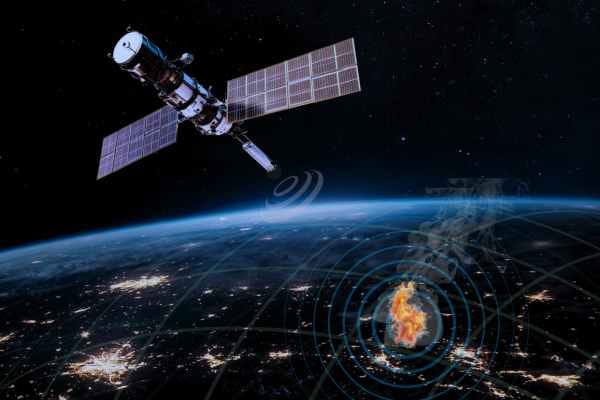
The global FireSat satellite constellation has been designed with this in mind. Developed by Californian non-profit Earth Fire Alliance (EFA) in collaboration with Muon Space and Google Research, it was named by Time Magazine as one of the best inventions of 2025.
FireSat's mission is to detect and track bushfires using multispectral infrared sensors to detect heat signatures rather than visible light, and its creators say it this allows it to sense beyond smoke and clouds to measure fire size, spread and intensity.
"These images represent a turning point in how the world will see and respond to wildfires. Our goal is simple: ensure that every fire, anywhere on Earth, is visible and understood in near real time."
EFA says FireSat can detect fires as small as 5x5 metres using its prototype satellite that was launched in March and is now being used by nine fire agencies across three continents. In July last year it revealed early images of fires it had detected, which included a fire near Borroloola in the Northern Territory.
“These images represent a turning point in how the world will see and respond to wildfires," EFA executive director Brian Collins says. "Our goal is simple: ensure that every fire, anywhere on Earth, is visible and understood in near real time.”
EFA says it plans to have a constellation of 50 satellites to scan the planet’s most fire-prone regions every 20 minutes by 2030.
Australia's Minderoo Foundation is among the partners supporting the development of EFA, and the Australian and New Zealand Council for Fire and Emergency Services and national science agency CSIRO are collaborating to boost the deployment of FireSat data locally.
“Our involvement in this project will allow CSIRO's fire science and wildfire predictive tools such as Spark to be scaled up globally helping to build disaster resilience in communities at risk,” senior CSIRO research scientist Mahesh Prakash said.
Operating at the heart of FireSat and many other next-generation fire detection technologies is artificial intelligence, providing the continuous monitoring and rapid anomaly detection essential to monitoring Australia’s vast and sparsely populated regions.
The Athena system developed by Kablamo for NSW Rural Fire Service also uses AI technology to blend GIS data, mapping, ignition points and wind to develop fire prediction models that can help fire commanders plan the most effective fire response on the ground and in the air.
Athena was developed in the wake of the Black Summer bushfires, and Kablamo says it converts bushfire data into meaningful intelligence to guide fire management efforts, adapting itself to the unique workflows, systems, communication platforms and preferences of individual fire-fighting agencies.
Caught on camera
Remote detection solutions that blend AI with satellite data and fire detection cameras are also gaining traction among fire agencies, utilities, forestry and landholders to scout for fires.
California-based startup Pano AI has established a bushfire detection network spanning many vulnerable regions in Australia that combines high-definition cameras with advanced triangulation, satellite feeds and artificial intelligence to detect new ignitions and alert fire crews.
Co-founded by an Australian expat living in the US, Pano AI was named as one of Time Magazines 100 most influential companies in 2025, and the company raised $68m last year to fund its global expansion across the US, Australia, and Canada.
Australian AI camera-based solution, Exci, is also being deployed to spot fires across the globe. Its fire detection system can integrate with a range of Pan Tilt Zoom (PTZ) cameras, according to its maker, to detect fire in high-risk environments such as wild–urban interface zones, national parks and plantations.
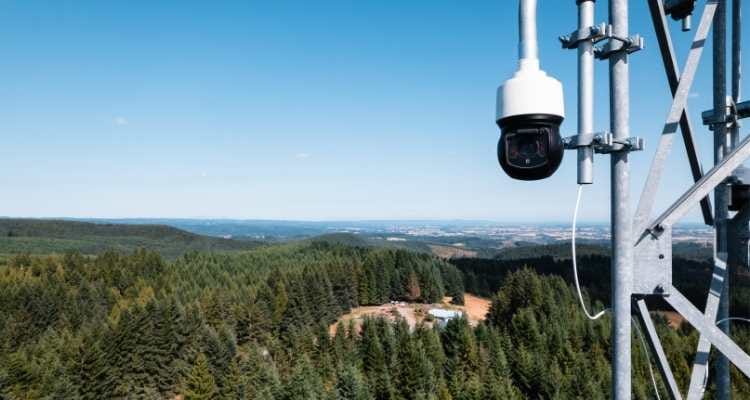
Another Australian startup rolling out an alternative fire detection solution is Fire Foresight, which blends sensory thermal and smoke data to extract real-time wildfire intelligence. The company says its system can autonomously detect fires at the smallest possible scale, pinpointing their exact location and then instantly alerting responders.
The company has been named as one of 15 semi-finalists in the XPRIZE Wildfire global competition for Autonomous Wildfire Response solutions, with finalists to be revealed later this year.
An early-warning fire solution taking a very different approach is Pyri, a small sensor made of wax and charcoal that was developed by a team of international students in the UK and won the UK Dyson award in 2024.
Pyri is shaped like a pinecone to blend into the habitat and can be dropped into remote forests or farmland by air. According to its creators, it melts when exposed to high temperatures, alerting nearby radio towers. The company says trials are ongoing with a commercial launch anticipated for 2027.
Drones on the frontline
Aerial drones armed with thermal imaging cameras present another promising tool for firefighters facing increasingly extreme conditions, helping to map fire fronts in real time and operate through the night when other aircraft are grounded.
Aerial drones developed by Sydney-based Carbonix have already been deployed over fire grounds, using thermal cameras to survey remote areas, support early fire detection, and provide crews with real-time situational updates. The company says its long-range Volanti drones can also aid fire prevention by assessing fuel loads and identifying smouldering tree trunks after lightning strikes.
Meanwhile, a new class of experimental drones is emerging, equipped with onboard fire-extinguishing systems designed to suppress smaller hotspots while human responders focus on battling larger blazes.
Canada's Candrone is developing a new range of heavy-lifting drones with the capacity to carry fire extinguishing balls. According to the company, the lightweight balls that can be carried by the drone are heat activated, releasing a dry chemical powder on contact that has shown in experiments to be able to extinguish a circle of short grass fire with a diameter of about one metre.
Taking a similar tack is the University of Maryland's Crossfire project. Also a semifinalist in the XPRIZE Wildfire competition, the team has developed an autonomous ‘Firejumper’ drone to extinguish small wildfires by dropping water balloons, which the university says has been validated in a live-fire demonstration.
A sonic approach
Another XPRIZE semi-finalist is German company Dryad Networks, which recently set up its first Australian office.
Alongside its range of rapid fire-sensing technology developed for ultra-early wildfire detection, the company is developing an autonomous firefighting drone called Silvaguard that it says can detect, locate, and then extinguish small fires using sonic technology.
Silvaguard has been designed to autonomously navigate environmentally challenging areas, locate the fire with its infrared and bio-activated cameras, then extinguish it using acoustic cannons using low-frequency sound waves to disrupt oxygen flow, starving the fire of the air it needs to burn, the company says.
Last year, Dryad announced it had created a fully functional prototype, with successful demonstrations of autonomous navigation to a fire site, and it says plans are underway to explore deployment opportunities in Australia where fast-moving fires pose a critical challenge, tapping into local expertise.
“Bushfires don’t just destroy landscapes and communities, they also fuel climate change. By reducing fire risk, we’re also cutting carbon emissions and building a more resilient future,” Dryad vice president Sohan Domingo says.
▸ In part two of our bushfire series we explore the next frontier of bushfire preparedness: embracing traditional wisdom and boosting urban resilience.
 Louisa Hearn