A new era for Australian energy
While fuel shortages roll out across the globe, one NSW community has found a powerful reason for optimism.

If there is a silver lining to the current global oil crisis, it could be a newfound enthusiasm for all things renewable.
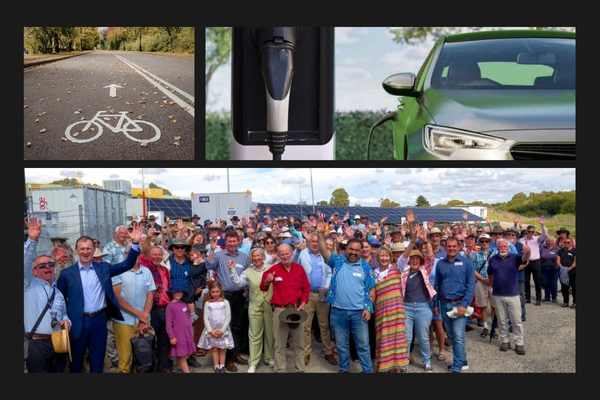
Last month, residents of Goulburn celebrated the completion of their community solar farm – the culmination of 12 years of meticulous planning and preparation.
At a time that has provided an energy wake-up call for many, the people of this regional city have finally secured a hard-won victory.
Though relatively modest in scale, comprising 2,300 panels and 1.4 megawatts of capacity, the addition of a 4-megawatt battery makes this one of the first community-led solar projects of its kind.
Paradoxically, attacks on climate science by then-Prime Minister Tony Abbott were what spurred the residents to embark on this ambitious journey. While in office in 2013 and 2014, Abbott abolished the Climate Commission, repealed the Carbon Tax, and famously declared that "coal is good for humanity".
Five years into the project, success arrived via a $2.1 million state grant, though the group was tasked with adding a battery and matching the funding themselves. They responded by forming a co-op and launching a prospectus.
In an extraordinary display of local spirit, 80% of residents pledged a total of $2.4 million in just six weeks. With Covid-era delays and reams of red tape finally behind them, construction began last year.
The solar farm is now operational and will soon deliver returns to its 288 local investors while generating enough energy to power approximately 500 homes.
“The powerful thing is these members now have a stake in a renewable energy power plant rather than leaving the clean energy market to large national and international interests," co-operative chair Andrew Bray said at the launch. “It is a great step in true benefit sharing.”
Just as past political friction rallied Goulburn, the current oil crisis, fueled by the aggressive fossil-fuel imperialism of the Trump administration and escalating conflicts in the Middle East, could inadvertently become a powerful catalyst for Australia’s renewable transition.
While record-high petrol prices are causing immediate pain, they are tipped to trigger a strategic pivot toward energy independence, with many hoping the crisis could serve as a wake-up call for clean energy investment.
Here are some of the clean, green silver linings emerging in Australia so far.
The era of the EV
As global oil prices hit historic highs, the resulting fuel crisis is providing the ultimate catalyst for many Australians to finally reconsider the internal combustion engine. If recent sales figures are any indication, the current geopolitical climate is ushering in the age of the electric vehicle.
"I don’t think there’s anyone out there today who has bought an electric vehicle who’s regretting the decision at this point in time,” Prime Minister Anthony Albanese said last week.
Despite long-held anxieties regarding range and infrastructure, demand for electric and hybrid models is reportedly surging across all sectors. Dealerships say they are seeing rapid sales growth, brokers are processing a wave of new loan applications, auction houses are seeing aggressive bidding for used models, and electric and hybrid rental cars are in hot demand.
In February, battery electric vehicles accounted for nearly 12% of total sales – a record monthly high according to the Federal Chamber of Automotive Industries. Furthermore, in February 2026, China, which now leads the world in EV sales, surpassed Japan as the nation’s leading vehicle source for the first time since 1998. As of last year, Chinese company BYD became the world’s largest seller of electric vehicles.
“Switching to an electric vehicle is saving households up to $3,000 per year in fuel and protecting them from volatile fuel prices," Electric Vehicle Council CEO Julie Delvecchio said.
“Every electric vehicle on the road reduces Australia’s reliance on imported petrol and diesel. That’s good for drivers and it’s good for the country.”
Reducing freight's footprint
The trucking industry has been among the hardest hit by rising fuel costs, with the financial burden ultimately expected to be passed on to consumers.
Road transport accounts for over 80% of Australia’s freight emissions, but electric trucks currently represent less than 1% of the market.
However, this crisis may help spark a shift to electric freight, if a coalition of 22 businesses and industry associations has its way. In a letter, the coalition writes about the economic opportunity of clean freight and notes that the technology is ready with dozens of electric models already commercially viable.
Investment is hampered, however, by a lack of national coordination and policy certainty, they say. They are urging the Federal Government to fast-track policies that unlock zero-emission freight to ensure Australia doesn't fall behind global competitors.
The group is calling for a national freight charging network and the backing of a Sydney–Melbourne “Hume Zero” corridor.
“By making electric trucks more financial accessible, and supporting the provision of high-capacity charging infrastructure, the government could substantially reduce the barriers that deter businesses from making the switch,” Coalition member, Australian Trucking Association CEO Mathew Munro said.
In a promising sign, the Australian Renewable Energy Agency (ARENA) announced up to $25.3 million in funding for NewVolt to develop a shared fast-charging network for heavy vehicles in Victoria.
“By backing shared charging infrastructure projects like NewVolt, Arena is lowering the barrier to entry for a broader spectrum of operators and building the foundations of a national electric freight network,” Arena CEO Darren Miller said.
Innovators like the Central Coast’s Janus Electric are also on the case, by converting diesel trucks to electric power using modular, Australian-made swappable battery systems.
Founder Lex Forsyth told ABC News that an increasing number of companies are now enquiring about fleet conversions.
Swinburne Professor Hussein Dia argues that Australia’s reliance on imported fuel reveals a lack of long-term strategy. With rising diesel costs driving up the price of food and freight, Dia warns that we should not wait for private EV adoption but instead focus on the rapid electrification of high-impact sectors.
"Waiting for households to gradually switch to electric cars will be slow," Dia wrote. "Working to electrify high-impact segments such as urban freight, commercial fleets, buses and government vehicles will be much faster. Over time, this should reduce the hundreds of tanker shipments needed to keep the country moving each year."
Fighting falsehoods
The oil crisis has underscored the volatility of a deeper issue: climate disinformation, which has recently been ranked as one of Australia’s primary security threats. Two recent reports reveal the staggering scale of these coordinated campaigns, and also propose some solutions.
The first, a final report from the Senate's select committee on information integrity, was tabled last week: The Integrity Gap: Restoring Trust in the Climate and Energy Debate.
The committee found that motivations behind disinformation range from “genuine community concerns through to ideological, political and commercial narratives that can amplify or delay climate action, protect established business models, or increase community divisions.”
Digital platforms are also under fire for using algorithms to amplify falsehoods, a cycle worsened by the rise of "AI slopaganda" and "astroturfing" – fake grassroots campaigns funded by corporate interests.
The second report, The Climate Disinformation War, was released by the Australian Security Leaders Climate Group (ASLCG). The report names fossil fuel dependence and disinformation as critical security risks and calls for urgent legislative intervention.
“Climate disinformation is evolving from a communications issue into a national security challenge, with implications for Australia’s sovereignty, economic resilience, disaster readiness, institutional trust, and strategic autonomy in shaping its energy transition amid intensifying geopolitical competition,” the report stated.
The ASLCG advocates for digital mandates that hold tech giants legally accountable and calls for "specific, strong, enforceable regulation" of generative AI.
Taxing gas windfalls
War and extreme weather have both exposed the fragility of our energy systems. Widespread gas infrastructure failures occurred during the recent Cyclone Narelle in WA – the third storm in history to make landfall across three Australian jurisdictions.
The Australian Conservation Foundation (ACF) noted the irony of the industry being crippled by the very extreme weather its pollution helps create.
“The current situation paints a bleak picture – extreme weather combined with global insecurity – shows how risky and vulnerable the Australian gas export industry is,” ACF climate and energy exports campaigner Piper Rollins said. “These problems aren’t going away – weather or war – Australia needs to break its addiction to fossil fuels.”
Consequently, several groups including Doctors for the Environment Australia, Bushfire Survivors for Climate Action, and Parents for Climate are calling for a 25% tax on gas exports. They propose directing the revenue toward frontline communities and households facing soaring insurance and energy costs.
There are positive signs on the horizon: ABC News recently reported that the Department of Prime Minister and Cabinet has requested Treasury modelling for "new levy options" ahead of the May federal budget to shield Australia from the impact of the war.
Big polluters pay
One Victorian council is taking the "polluter pays" principle even further. The local council is calling for a National Climate Compensation Fund Following a bushfire that destroyed over 50 homes in Mount Alexander Shire in January.
Councillor Lucas Maddock, who moved the motion, said: “If we don’t get the big polluters to pay for the damage they are doing it will be our residents, business and farmers left paying for it through increased levies and rates, cut services, or further diversion of our taxes – which should be funding our kinders, schools, health services and roads.”
With 2025 ranking as one of the warmest years in history, many communities are facing "climate whiplash” with some postcodes swinging rapidly between floods, fires, or heatwaves.
A new Climate Council report suggests human-induced climate change is now overriding natural cycles, such as the cooler La Niña phase. The Climate Council estimates these disasters now cost Australia $38 billion annually.
Psychologist Dr Susie Burke warns the toll on communities is more than financial. “When people live through fires, floods and drought in quick succession – and face rising insurance costs, damaged infrastructure and ongoing uncertainty – the psychological burden compounds.”
Redesigning daily life
As economic and environmental pressures converge, academics are calling for a systemic overhaul of how we live and move.
Monash University experts are urging the government to rethink mobility systems by prioritising walking, cycling, and subsidised public transport.
“The case for shifting short trips to walking and cycling has never been stronger, on health, climate, liveability, and now household economics,” Dr Lauren Pearson of Monash University said.
States are responding, with Tasmania and Victoria recently announcing periods of free public transport, while Queensland made 50-cent fares permanent in 2024 as a "cost-of-living" relief measure. To date, NSW has resisted similar calls.
New University of Tasmania research shows that walkable neighbourhoods also provide health benefits, with residents living in them walking 75 minutes more each week, prompting calls for governments to invest in well-connected, safe footpaths.
Traditionally, government planning and funding has prioritised roads and driving, especially in regional areas, one of the authors, Professor Verity Cleland said. "Our research uncovered a higher number of regional areas that had low walkability compared to urban areas."
Food security is also coming into focus, with Kimberley Reis of Griffith University calling for a "place-based" approach to food.
“This shock to our food system is not the first and won’t be the last,” Reis said. “Governments need to encourage people to have a contingency for tough times.
"It might mean taking time to work out where the local suppliers are, what food is in season in your area, and how you can support local farming co-operatives.”