Sowing the seeds of change
From solar-powered production and collaboration on methane to AI-driven waste recovery, we take a look at three new projects addressing agricultural sustainability.

Agriculture has long been central to Australia’s economy and identity, but it also carries a significant climate footprint.
In Australia, the sector accounts for around 18% of total climate pollution, according to the Climate Council. As an industry, agriculture is also far more exposed than most to the growing impacts of climate change, including more frequent, extreme and unpredictable weather.
But the story isn’t all about challenge. Increasingly, it’s one of innovation, with farmers and agribusinesses adopting new technologies to cut emissions, use resources more efficiently and extract more value from what they have. Here are three recent projects that aim to deliver wins for both bottom lines and the climate.
Cargill adopts solar at scale
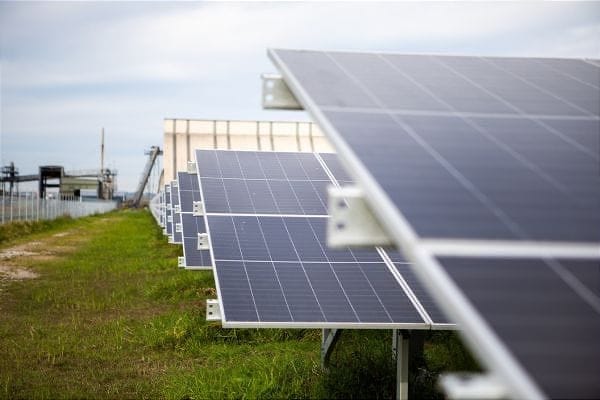
Global agricultural commodities company Cargill has begun generating its own renewable energy onsite at its oilseed processing facility at Newcastle, NSW with the installation of a utility-scale solar array.
At Cargill, around 4,000 solar panels form a 2.58 MW installation built and fully owned by the company on-site, a step beyond the more common approach of rooftop solar or buying clean energy from third-party suppliers to meet sustainability goals.
Cargill said the asset will generate more than 4,200 MWh of renewable electricity annually, matching the demand of the processing facility at peak times and reducing the company’s electricity costs by $600,000 annually.
The project will also reduce its emissions by around 2,700 tonnes of CO₂ each year, according to Cargill, the equivalent electricity consumption of about 700 NSW households, in line with the company’s global commitment to reduce absolute Scope 1 and 2 emissions by 25% by 2035.
"By integrating renewable energy directly into our manufacturing infrastructure, we reduce emissions, enhance resilience and create lasting value"
It’s Cargill’s first large-scale renewable energy project in Australia and, according to the company, is the only fully-owned solar system of its size by an oilseed manufacturer in Australia.
Cargill, which refines local canola and cottonseed, as well as imported vegetable oils, said its investment in a large-scale, self-owned and operated utility-style array aims to provide the company with more energy resilience and cost certainty, as well as meeting its emissions targets.
“This has been built on Cargill land, it’s been built by Cargill directly as a project, and it’s fully funded and owned by Cargill,” said Cargill’s senior director of regional operations SSEA-Australia, Nick Ebrill.
“This initiative is about taking real, practical steps toward sustainability and innovation,” he said. “By integrating renewable energy directly into our manufacturing infrastructure, we reduce emissions, enhance resilience and create lasting value."
Majors join forces on methane
Australia’s agriculture sector carries a hefty climate footprint, and methane from ruminant livestock makes up the biggest share of it – about 70 per cent, according to Australia’s National Greenhouse Gas Inventory data.
Livestock emissions were also responsible for more than half of Australia’s methane output in 2022–23, according to the Climate Council, with nearly 65 per cent of climate pollution coming from the methane cattle produce as they digest their food.
A growing number of startups are tackling the problem, with most focused on the methane-busting potential of a red seaweed native to Australia called Asparagopsis.
One of them, Sea Forest, produces a feed supplement known as SeaFeed which, according to the company, has shown well-established reductions in livestock methane emissions of up to 80 per cent across multiple peer-reviewed studies.
Sea Forest is now stepping things up, announcing a newly signed multi-year collaboration with Australian supermarket giant Woolworths, meat producer Teys Australia, and livestock supplements and dosing specialist DIT AgTech.
"With SeaFeed we’re replicating and harnessing the bioactives in Asparagopsis to deliver measurable methane reductions in real-world conditions"
Together, the partners are planning a commercial-scale trial of SeaFeed at a cattle farm in NSW. The trial will test both dry-lick and water-delivered formulations, with the latter administered using dosing technology designed to enable delivery at scale.
Backed by investment from all four partners, the trial aims to validate the concept, with results to be independently verified against globally recognised standards. Alongside significant methane reductions, the partners are also looking for productivity gains, including improved weight gain and feed efficiency.
The group says it is committed to sharing key learnings and outcomes with the broader industry as the program progresses, helping to drive wider adoption and position the Australian beef value chain ahead of its global peers.
“With SeaFeed we’re replicating and harnessing the bioactives in Asparagopsis to deliver measurable methane reductions in real-world conditions,” Sea Forest founder and CEO Sam Elsom said.
“Partnering on this grass-fed trial helps validate animal performance outcomes delivered in addition to the established emissions reduction and supports the scalable adoption of a science-based solution for producers and retailers.”
Fermentation to feed the world
In Australia alone, more than seven million tonnes of food – a third of all produced – go to waste each year, according to Food System Horizons, a collaborative initiative funded by The University of Queensland and CSIRO.
A global partnership, including CSIRO, aims to harness AI to transform agrifood waste into protein ingredients at scale. CSIRO researchers are teaming up with the University of Leeds in the UK to develop an AI-powered tool that uses fermentation to convert waste into high-quality, sustainable protein for food production.
The project will focus on three types of agrifood waste: damaged or unharvested vegetable crops, grain byproducts like canola or brewer’s spent grain, and cheese-making residues.
The technology could lessen dependence on resource-intensive protein sources and bolster food security amid rising concerns about waste and sustainability, as well as reducing emissions associated with the disposal of agrifood waste.
"When fermented using yeast, for example, food waste can be transformed into valuable products within the framework of a circular bioeconomy"
The AI tool will calculate optimal fermentation conditions to produce microbial protein powder suitable for human or animal consumption, with the goal of making upcycled protein at scale that can compete with conventional alternatives.
“Working with our colleagues internationally, this project will combine AI, fermentation science and real case studies to support industry to turn that waste into sustainable protein at scale,” CSIRO project lead Dr Kai Knoerzer said.
Fermentation has long been used to preserve bread, cheese and wine, he said, and could play a much larger role in strengthening global food security. “When fermented using yeast, for example, food waste can be transformed into valuable products within the framework of a circular bioeconomy.”
University of Leeds Professor of Artificial Intelligence in Food Dr Nicholas Watson said to truly impact global food security, upcycled protein couldn’t just be a niche alternative, but had to compete on price with what is already on the supermarket shelf.
The $3 million project will run for two years and is supported by the Bezos Earth Fund’s AI for Climate and Nature Grand Challenge, a $100 million initiative that aims to harness AI to tackle climate change and biodiversity loss.