A second life for solar
An Australian pilot aims to recover valuable materials from discarded solar panels instead of dumping them in landfill.

A new pilot program to recycle solar panels will be rolled out by the federal government to boost the circular credentials of the clean energy sector.
This week the Australian Energy Market Operator announced what it described as a "landmark moment" as renewables delivered more than 50 per cent of Australia's quarterly energy supply for the first time – helping to cut wholesale electricity prices by nearly half.
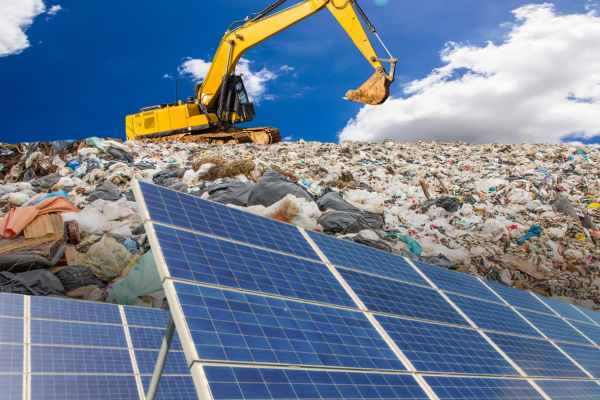
Australia boasts one of the highest rates of rooftop solar adoption globally with more than one in three homes now fitted with solar panels. Yet the government says only 17 per cent of panels are currently recycled at the end of their working life, with most ending up in landfill.
“Only a small percentage of end-of-life solar panels are currently recovered for recycling with most panels are either stockpiled, dumped in landfill or exported for reuse,” Minister for the Environment, Murray Watt says.
The materials within the panels include copper, silver and aluminium, and Watt says these could be repurposed to “support the clean energy transition and help reduce what we send to landfill, improving our natural environment”.
To this end, the government says it will invest $24.7 million over three years to establish up to 100 pilot collection sites across the country to help manage the growing volume of end-of-life solar waste.
According to figures cited by the government, recycling panels could unlock up to $7.3 billion in benefits by reducing waste and expanding the reuse of materials.
"Only a small percentage of end-of-life solar panels are currently recovered for recycling with most panels are either stockpiled, dumped in landfill or exported for reuse."
This new recycling initiative follows the release of a Productivity Commission report into Australia’s circular economy, which found that better coordination, regulation and innovation would enable the retrieval of high-value materials within solar panels.
The government says its pilot is intended to inform a longer-term national approach, and it plans run a tender process early this year to identify a delivery partner for the pilot.
In a separate announcement, the federal government also this week revealed that its Solar Sharer Offer, announced last year, would commence in July 2026.
Under the opt-in Solar Sharer Offer, electricity retailers in New South Wales, South Australia and south-east Queensland will be required to provide at least three hours of free electricity during the middle of the day, aimed at making better use of Australia’s abundant solar capacity.
The government said the Australian Energy Regulator would oversee the rollout, with other states potentially joining from 2027.
Most large-scale solar panels last around 25–30 years according to the Clean Energy Council, which means Australia is approaching a surge in end-of-life panels that will need to be managed. While solar panels are made up of about 95% recyclable materials, including glass, aluminium, silicon and small amounts of valuable metals, recycling them is technically complex. Panels must be carefully dismantled into separate components, and only some parts, such as aluminium frames and junction boxes, are routinely recovered, according to the Clean Energy Council. Extracting higher-value materials like silicon and silver, it says, requires more specialised facilities, which are still under development in Australia.